Integrating Social Media With Your CMS

Integrating social media with your CMS establishes a robust foundation for enhancing your digital marketing strategies. This integration streamlines content sharing and ensures real-time updates across all platforms. It enables the effortless delivery of consistent brand messages while leveraging user-generated content to enrich your website's experience. Analytics tools allow you to refine engagement strategies and optimize posting schedules, thereby driving user retention and conversions. Ready to seamlessly blend these powerful tools for your business? Let's explore how to make this integration work effectively for you.
Benefits of Headless CMS
When seeking ways to optimize your content management, a Headless CMS offers substantial benefits worth considering. By decoupling the back-end content repository from the front-end presentation layer, a headless CMS provides unparalleled flexibility. This separation allows the creation of seamless digital experiences across various devices and platforms, significantly enhancing digital marketing efforts.
A major advantage is its ability to integrate with social media, ensuring brand consistency and streamlined content sharing. A headless CMS facilitates the synchronization of content across different channels, creating cohesive omnichannel experiences. This consistency ensures that your message remains uniform, regardless of where your audience encounters it.
Furthermore, a headless CMS accelerates the publishing process, enabling real-time updates. You can push new content quickly and efficiently, keeping your audience engaged with the latest information. The decoupled architecture allows backend work to proceed without disrupting front-end development, leading to faster deployment and reduced development costs.
Content creators will appreciate the ability to reuse and remix content efficiently, saving time and resources. This approach not only reduces operational costs but also enhances return on investment (ROI). In summary, a Headless CMS is a transformative tool for modern digital marketing and content management, offering semantic interoperability and ensuring trustworthy, relevant, and consistent content delivery.
Social Media's Digital Role
In today's digital landscape, social media is crucial for businesses looking to engage with their audiences. With over 4 billion users worldwide, social media platforms are essential components of your marketing strategy. Integrating social media with your content management system (CMS) streamlines content creation and distribution, enhancing both brand awareness and engagement.
Utilizing social media allows you to broaden your customer reach and enrich website content with user-generated contributions, making it more relatable and authentic. Built-in analytics tools provide immediate insights into social media performance, enabling you to understand what resonates with your audience without the need for additional software. This data is invaluable for refining your marketing strategy to ensure it aligns with your overall business goals.
Personalization is vital in the current online environment. Customizing content for your audience on social media platforms enhances user experience and fosters loyalty. Integrating social media into your CMS is not just a trend but a necessity for staying competitive. It enables you to manage and measure your online presence effectively, ensuring your brand remains visible and relevant in a rapidly evolving digital world.
Selecting the Right Platforms
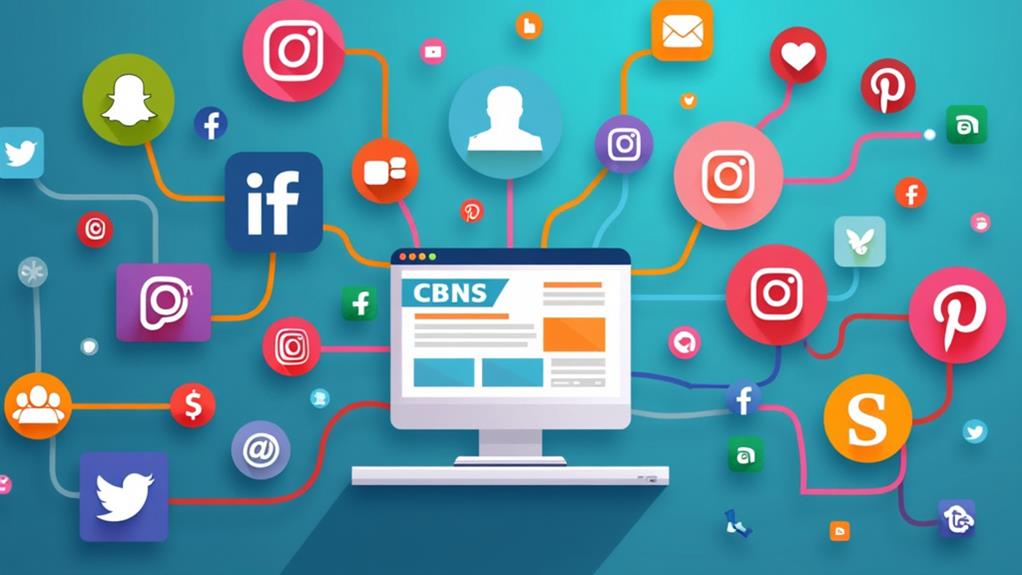
Choosing the right social media platforms is crucial for maximizing your business's online impact. Different platforms serve distinct user demographics. For example, LinkedIn is ideal for B2B professionals, while Instagram and Snapchat are popular among younger users. By carefully selecting platforms that align with your business goals, you can effectively reach your target audience.
To guide your decision, consider the following:
| Platform | Target Audience | Key Strengths |
|---|---|---|
| B2B professionals | Networking, B2B leads | |
| Younger demographics | Visual content | |
| Snapchat | Teens and young adults | Ephemeral content |
Understanding audience preferences is essential. Conducting a thorough audit of your social media accounts ensures alignment with your business objectives and relevance to your target audience. This enhances overall engagement and visibility.
Utilize analytics tools to monitor engagement metrics on your chosen platforms. This data allows you to refine your strategies and optimize your social media presence. With over 4 billion active social media users today, projected to reach 5.8 billion by 2027, selecting the right platforms is key to standing out in this growing online environment.
Methods for Integration
To seamlessly integrate social media with your Content Management System (CMS), start by embedding social widgets, such as sharing buttons and real-time post feeds, directly on your website. This approach not only enhances user engagement but also keeps your content dynamic and up-to-date. Additionally, automate content sharing with tools like Hootsuite or Buffer to maintain a consistent online presence without the need for manual updates.
Embedding Social Widgets
Integrating social widgets into your CMS is a strategic move to enhance user engagement and brand visibility. By embedding these widgets, such as share buttons and social feeds, you facilitate seamless social media integration, making it easier for visitors to interact with your content. These widgets provide real-time updates, ensuring your site remains fresh and dynamic.
Tools like Hootsuite and Buffer allow for effortless integration of social media feeds, showcasing user-generated content and enhancing user engagement. Customizing these widgets ensures they align with your site's design, creating a cohesive brand aesthetic.
Additionally, implementing social login options can streamline the user experience, boosting registrations and interactions. Visitors can log in using their social media accounts, simplifying the process. Regularly updating embedded social content keeps your site relevant and fosters community engagement. This approach transforms your website into a dynamic platform, continually engaging users and amplifying your brand's visibility.
Automating Content Sharing
Automating content sharing can revolutionize the way you manage your social media presence, making it more efficient and consistent. By integrating social media sharing capabilities directly into your Content Management System (CMS), you simplify the process of distributing your content across various platforms. Embedding social sharing buttons within your CMS enables one-click content sharing, significantly boosting engagement and driving more traffic to your site.
Utilize automation tools like Buffer or Hootsuite to schedule posts across multiple social media platforms concurrently, ensuring your content is consistently distributed. These tools synchronize updates in real-time across all platforms via social media APIs, keeping your audience engaged and informed.
Implement a content calendar within your CMS to streamline the planning and scheduling of social media posts. This not only enhances your organizational capabilities but also improves the efficiency of your content strategy management. Additionally, leverage built-in analytics tools to track engagement metrics and automate performance reporting. This data-driven approach allows you to make informed adjustments, optimizing your overall social media strategy.
Optimizing Integration Strategies

To optimize your integration strategies, focus on enhancing content engagement by leveraging user-generated content and branded hashtag feeds. Streamline your post scheduling with a CMS that supports seamless content planning and automatic posting. Regularly audit and monitor performance metrics to ensure alignment with audience preferences and business goals.
Enhancing Content Engagement
To significantly boost content engagement on your website, optimizing your CMS integration strategies is essential. One effective approach is to incorporate user-generated content (UGC). This strategy can elevate engagement by up to 79%, as it builds social proof and fosters a sense of community around your brand.
Another tactic is to utilize branded hashtag feeds, which enable followers to discover the latest posts. This can drive engagement and encourage cross-promotion among users. Embedding social media posts directly on your website can also enhance traffic back to your social accounts, improving visibility and interaction with your content.
Don't underestimate the power of social sharing buttons. Adding these to product pages can significantly enhance conversion rates, with studies showing up to a 200% increase in sales for products with share buttons. Regularly updating social media feeds on your site ensures visitors see fresh content, potentially leading to a 30% rise in user retention rates.
Streamlining Post Scheduling
Streamlining post scheduling within your CMS can transform your content delivery process, ensuring efficiency and consistency across all social media platforms. By leveraging scheduling features or plugins within your CMS, you can automate posts across multiple channels, saving time and maintaining a steady flow of content. Here's how to effectively streamline post scheduling:
- Create a content calendar: Plan and organize your posts in advance to maintain a consistent posting schedule, thereby enhancing audience engagement.
- Utilize analytics tools: Monitor engagement metrics to make data-driven adjustments and optimize future post scheduling.
- Implement social media management tools: Use tools like Buffer or Hootsuite for synchronized scheduling and performance tracking across all channels.
- Schedule posts at ideal times: Regularly review audience activity patterns and adjust your schedule to ensure content is shared when your audience is most active.
- Enhance efficiency with CMS features: Utilize built-in CMS tools or plugins to automate post scheduling, ensuring a seamless content delivery process.
Automation in Content Management
Automation in content management revolutionizes how businesses handle their social media presence by enabling advanced scheduling and consistent engagement. Leveraging automation simplifies the management of multiple social media accounts. Tools like Buffer and Hootsuite offer centralized scheduling and posting, ensuring that your content is consistently delivered across various platforms.
Built-in analytics tools in a headless CMS enable you to track key metrics such as views, shares, and conversions. This data-driven approach allows for effective adjustments to content strategies. Automation not only reduces operational costs but also shortens publishing times, enabling rapid responses to market trends and customer demands.
Furthermore, centralized content management through automation minimizes the risk of content duplication and enhances team collaboration. Improved workflow efficiency means that content creators and managers can work seamlessly together to produce high-quality content faster. By integrating these automation features, you can enhance your social media strategy, ensuring sustained audience engagement and brand relevance in a competitive market.
Case Studies and Success Stories

How can integrating social media with your CMS revolutionize your business? Let's explore some compelling case studies and success stories.
The LADbible Group experienced a fivefold increase in editorial speed and enhanced customization for 55 brand sites after integrating a headless CMS with social media capabilities. This integration brought significant operational efficiency, enabling their team to focus on real-time engagement and timely content updates.
MoneyHero Group transitioned from complex processes to streamlined content updates and publishing with Contentstack's headless CMS. The integration of social media features facilitated seamless and efficient real-time engagement, underscoring the importance of operational efficiency.
Businesses leveraging user-generated content through integrated social media platforms witnessed a notable rise in consumer trust. Specifically, 78% of consumers are more likely to purchase from brands following positive interactions on social media.
These success stories emphasize the importance of continuously evaluating and optimizing social media strategies to achieve:
- Improved brand visibility
- Enhanced audience connection
- Increased user engagement and conversions
- Streamlined content updates
- Strengthened consumer trust
Future Trends in CMS Integration
With the rapid evolution of technology, future trends in CMS integration are set to transform how businesses manage and distribute content. CMS platforms will increasingly leverage social media integration to streamline cross-platform publishing and engagement. Given that social media usage is projected to reach 5.8 billion users by 2027, integrating these platforms will be essential for reaching wider audiences.
Predictive analytics powered by AI and machine learning will enhance content strategies by tailoring them to user behavior and trends. This means your CMS will help you anticipate audience preferences, elevating engagement and satisfaction.
Automation capabilities will play a significant role, enabling real-time updates and performance tracking. This will not only reduce operational costs but also increase efficiency in content management. The rise of headless CMS systems offers more flexible content management solutions, allowing seamless integration with social media without disrupting front-end development.
Enhanced personalization features will cater to evolving consumer expectations. With 78% of consumers more likely to purchase from brands after positive social media interactions, personalized content will be crucial for driving conversions and loyalty. Future CMS integrations will make meeting these expectations easier than ever.