
Predictive Inventory Management: Optimizing Stock Levels With AI

Imagine managing a business where inventory levels are crucial to your profitability. Predictive inventory management, powered by artificial intelligence (AI), offers a transformative solution for stock handling. By analyzing historical sales data and external factors such as seasonality, AI can forecast demand with remarkable accuracy. This results in fewer stockouts and reduced overstocking, leading to better inventory turnover and more available capital.
But how does AI achieve this, and what are the steps to implement such a system effectively? Understanding these critical aspects is essential for leveraging predictive inventory management to its fullest potential.
Understanding Predictive Inventory Management
Why is predictive inventory management a transformative tool for modern retailers? It leverages AI-driven predictive analytics to forecast future demand with high accuracy. By analyzing historical sales data and integrating external factors such as seasonality, promotions, and social media trends, retailers can maintain optimal stock levels. This strategy significantly mitigates the risks of stockouts and overstocking, ensuring that the right products are always available for customers.
One of the primary advantages is real-time data processing, enabling swift decision-making. Retailers can dynamically adapt to market changes and consumer behavior, thereby enhancing service levels and customer satisfaction. Predictive inventory management also boosts inventory turnover rates. Accurate demand forecasting ensures efficient stock movement, freeing up capital and reducing holding costs.
Additionally, refining inventory distribution based on demographic insights allows retailers to place the right products in the right locations. This not only improves service levels by 10-20% but also can lead to cost savings of 20-50% in inventory levels and holding costs. In summary, predictive inventory management is a powerful tool for any retailer aiming to stay competitive and responsive in a dynamic market.
AI Techniques for Inventory Optimization
Building on the advantages of predictive inventory management, AI techniques elevate efficiency by leveraging machine learning algorithms to analyze historical sales data and market trends. This enables highly accurate demand forecasting, helping to maintain optimal stock levels and avoid issues like overstocking or stockouts.
Predictive analytics combines real-time data with historical trends to identify potential demand fluctuations. This allows proactive inventory adjustments, ensuring preparedness for market changes. Inventory segmentation techniques further enhance the strategy by categorizing products based on demand patterns, shelf life, and profitability, facilitating more precise management.
AI-driven optimization models use complex algorithms to refine inventory allocation strategies, minimizing excess stock and reducing carrying costs. Advanced AI technologies, such as natural language processing and computer vision, streamline data collection and improve stock monitoring accuracy. Integrating these AI techniques enhances inventory management capabilities, ensuring competitiveness in the market.
Implementing AI in Inventory Systems
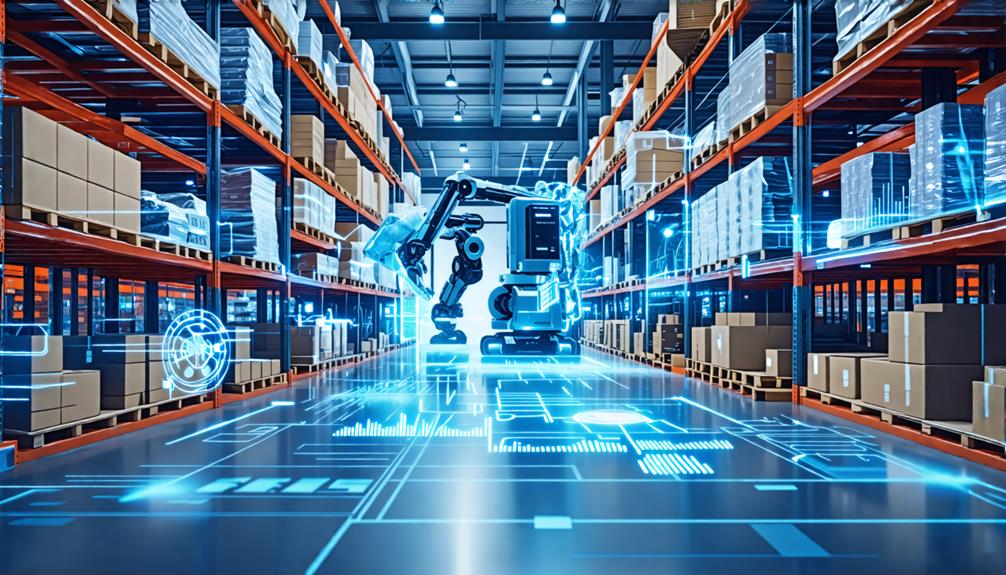
Implementing AI in inventory systems revolutionizes stock management, delivering substantial operational benefits. AI-driven inventory optimization can significantly reduce inventory levels and holding costs by 20-50%. Through predictive analytics, AI enhances demand forecasting accuracy by analyzing historical data and external factors such as seasonality and market trends.
Integrating AI with existing systems allows for real-time monitoring, enabling timely decision-making to avoid costly stockouts or overstock situations. AI automates repetitive tasks like inventory updates and stocktaking, reducing human errors and freeing resources for strategic initiatives. This automation boosts operational efficiency, ensuring optimal stock levels.
Companies adopting AI for inventory management often experience a 10-20% improvement in service levels and On-Time-In-Full (OTIF) performance, leading to increased customer satisfaction. Accurate demand forecasting, real-time monitoring, and automated processes make inventory systems more responsive and efficient, driving better business outcomes and enhancing customer experiences.
Benefits of AI-Driven Inventory Management
By leveraging AI-driven inventory management, businesses can achieve cost efficiency gains of 20-50% through reduced inventory levels and holding costs. Real-time adjustments and accurate demand forecasting minimize stockouts and overstock situations, ensuring optimal stock levels. Additionally, improved forecast accuracy enhances service levels and customer satisfaction, thereby increasing overall operational efficiency.
Cost Efficiency Gains
Efficiency takes center stage with AI-driven inventory management, offering substantial cost benefits. Leveraging AI solutions can lead to significant cost efficiency gains, including potential reductions of 20-50% in both inventory levels and holding costs. This optimization not only reduces waste but also frees up valuable cash flow for other investments.
AI's accurate demand forecasting minimizes overstocking and deadstock, cutting down on costly markdowns and improving profit margins. Enhanced inventory turnover rates, driven by predictive analytics, ensure faster product movement, reducing carrying costs and improving cash flow management. Additionally, automation streamlines inventory processes, significantly lowering labor costs associated with manual tracking.
Here's a snapshot of the benefits:
| AI-Driven Benefits | Impact |
|---|---|
| Inventory Level Reduction | 20-50% decrease |
| Shipping Cost Savings | 15-30% decrease |
| Overstock & Deadstock | Minimized, reducing markdowns |
| Inventory Turnover | Faster rates, better cash flow |
Real-Time Adjustments
Real-time adjustments in inventory management offer transformative benefits through AI-driven solutions. These advanced systems enable rapid responses to demand changes, optimizing reorder points and minimizing stockouts. Machine learning algorithms analyze live data to maintain ideal stock levels, reducing holding costs by 20-50%.
Leveraging historical sales data and current market trends, AI enhances the accuracy of inventory forecasts, allowing seamless adaptation to seasonal variations and improving stock turnover rates. Automated inventory tracking via AI eliminates human errors and inefficiencies, streamlining workflows and facilitating timely decision-making.
One standout benefit is the real-time insights provided by AI systems. These insights enhance demand forecast accuracy, improving service levels and On-Time-In-Full (OTIF) performance by 10-20%. This boosts supply chain efficiency, ensuring consistent adherence to customer service agreements.
AI-driven inventory management transcends mere stock tracking; it empowers smarter, faster decision-making, keeping your business agile and responsive. Real-time adjustments help you stay ahead of demand fluctuations, ensuring your inventory aligns with market needs.
Enhanced Forecast Accuracy
Leveraging real-time adjustments and enhanced forecast accuracy marks a significant advancement in AI-driven inventory management. Machine learning algorithms analyze historical sales data to boost forecast accuracy, reducing stockouts by 20-30%. Predictive analytics further refine demand forecasting by incorporating external factors such as seasonality and market trends, achieving a 10-20% improvement over traditional methods.
Real-time data analysis enables AI systems to dynamically adjust inventory levels, reducing excess stock and associated holding costs by 15-30%. This optimization enhances inventory turnover and operational efficiency. Integrating AI with customer behavior insights personalizes inventory strategies, boosting both sales effectiveness and customer satisfaction.
AI's ability to swiftly process extensive datasets ensures well-informed decisions that optimize inventory turnover rates, allowing businesses to respond to market demands with greater agility and precision. The synergy between historical sales data, real-time analysis, and predictive analytics empowers businesses to maintain a finely tuned inventory, driving overall operational efficiency and profitability. Enhanced forecast accuracy is a transformative element in modern inventory management.
Challenges in AI Integration

Integrating AI into inventory management presents several challenges that need to be addressed to ensure successful implementation. One primary concern is data quality and availability; unreliable data can significantly undermine the effectiveness of AI algorithms, making the investment less fruitful. Implementation costs are another considerable challenge, as substantial investment in both technology and infrastructure is required to support AI solutions effectively.
The skills gap within your team is another critical issue. Your current staff may lack the expertise needed to manage AI technology, necessitating investment in training programs or seeking external partnerships to equip your personnel with the necessary skills. Additionally, integrating AI with existing legacy systems can be complex and time-consuming, often requiring significant modifications to ensure compatibility, which can strain resources.
Security and privacy concerns are also paramount. Handling sensitive data requires robust security protocols and compliance with data protection regulations to safeguard your business and customer information. By addressing these challenges—data quality, implementation costs, skills gap, legacy system integration, and security and privacy concerns—you can better prepare your organization for successful AI integration in inventory management.
Future Trends in AI Inventory Management
The future of AI in inventory management promises a significant transformation, driven by advanced technologies that will revolutionize the field. Enhanced predictive analytics will enable the incorporation of external factors such as market trends and social media signals to optimize stock levels and demand forecasting. This AI-driven approach ensures you are consistently ahead, minimizing both stockouts and overstock situations.
Integrating the Internet of Things (IoT) into inventory systems will allow for real-time monitoring of stock levels. IoT devices will provide immediate insights into inventory status, making supply chains more agile and responsive. This real-time monitoring improves operational efficiency, enabling rapid resolution of discrepancies and issues.
Additionally, the adoption of computer vision technology for automated inventory tracking will increase accuracy and reduce manual errors. Inventory audits and stock checks will become faster and more reliable. Advancements in natural language processing (NLP) will also enhance user interfaces, making interactions with inventory management systems more intuitive and efficient.
These developments collectively ensure a more efficient, accurate, and responsive inventory management system, fostering better supply chain management and operational excellence.
Related posts