
When Was FORTRAN Created?
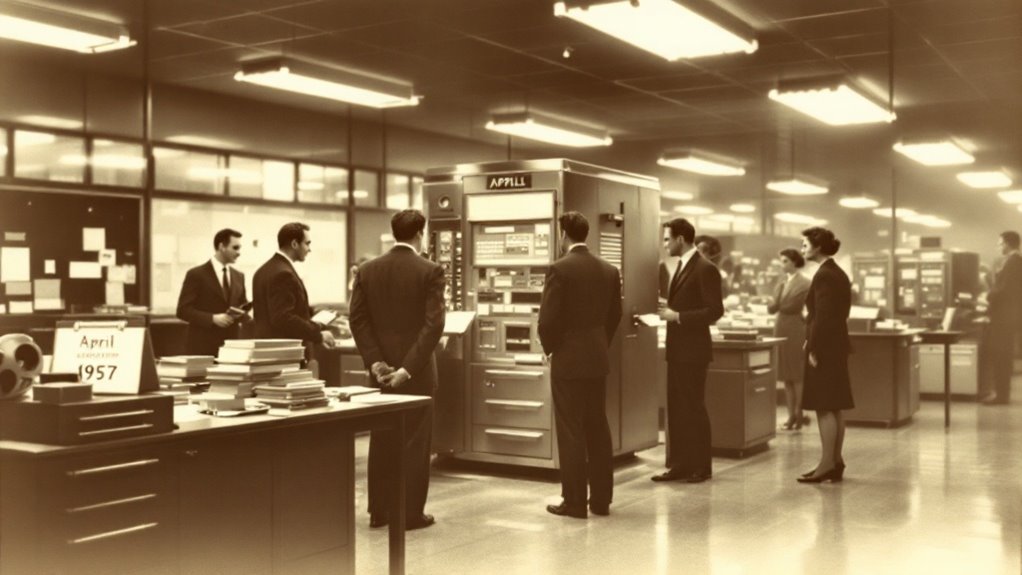
You're curious about FORTRAN's creation. It all began in December 1953 when John Backus and his team at IBM decided to revolutionize programming by simplifying complex machine codes. The primary FORTRAN manual came out in October 1956, guiding users in this new language. By April 1957, the original operational FORTRAN compiler was delivered, marking the debut of the first high-level language compiler. Despite early skepticism about its efficiency, FORTRAN quickly gained traction across numerous industries.
Over time, it evolved, experiencing several updates to improve its capabilities. There's much more to uncover about its fascinating expedition.
Origins of FORTRAN
The genesis of FORTRAN lies in the ambition to revolutionize the way people interacted with computers. In an age dominated by complex machine code, John Backus and his team at IBM sought to simplify programming, making it accessible for scientists and engineers. Proposed in December 1953, the FORTRAN project aimed to create a programming language that used algebraic notation instead of the cryptic assembly language of the time.
By 1957, this vision materialized when the initial FORTRAN compiler was delivered, providing an operational language that transformed computational tasks. This breakthrough enabled users to write instructions in a more intuitive, mathematical form, which the compiler would then translate into machine code for the IBM 704 mainframe computer. As a result, FORTRAN became the primary high-level programming language, bridging the gap between human thought and machine execution.
The publication of FORTRAN's initial manual in October 1956 further solidified its impact by offering thorough guidance on its features. FORTRAN empowered individuals without extensive programming knowledge to engage with computers effectively, marking a critical moment in computing history. It laid the groundwork for future innovations, forever changing how programs were written and understood.
The Role of John Backus
Amidst the rapidly evolving landscape of early computer science, John Backus played a significant role in transforming programming with his groundbreaking creation, FORTRAN. Back in December 1953, he proposed the ambitious FORTRAN project with a vision to develop a high-level programming language that would simplify coding for scientific applications. By leading a team at IBM, Backus initiated a mission to make programming more accessible and efficient. His leadership and creative spirit resulted in FORTRAN being compiled successfully in April 1957, a milestone that marked a significant advancement in programming languages.
One of Backus's remarkable contributions was the development of the initial optimizing compiler for FORTRAN. This achievement drastically increased programmer productivity by reducing the complexity of coding tasks. What once required about 1000 instructions could now be accomplished with just 47, thanks to FORTRAN's design that prioritized capturing human intent. This complexity reduction not only made programming more intuitive but also cut costs, making computing more accessible.
John Backus's vision for FORTRAN established it as a foundational language in scientific and engineering computing. His work profoundly influenced the development of subsequent programming languages, laying the groundwork for future advancements.
Development Timeline
Imagine a time when programming required intricate and laborious coding. In the early 1950s, John Backus proposed a groundbreaking solution: FORTRAN, a high-level programming language aimed at simplifying coding for IBM. The development timeline of FORTRAN marked significant milestones that transformed computing. By December 1953, Backus had initiated the project, setting the stage for a revolutionary change.
The initial manual for FORTRAN was published in October 1956, providing users with crucial guidance on using this new language. It set the foundation for the successful compilation of the primary FORTRAN compiler in April 1957, which was a critical moment in programming language development. This achievement made FORTRAN the first high-level language to have a working compiler, allowing developers to write more efficient and readable code.
FORTRAN II emerged in 1958, introducing procedural programming features that expanded its capabilities and appeal. This release further solidified FORTRAN's place in scientific computing, leading to its rapid adoption. By 1963, over 40 different FORTRAN compilers existed, a reflection of its popularity and versatility. Through these developments, FORTRAN became an indispensable tool for IBM and the wider scientific community, fundamentally changing the landscape of programming languages.
Key Innovations
Building on FORTRAN's remarkable development timeline, we investigate its key innovations that redefined programming. As the primary high-level programming language, FORTRAN transformed how you approached scientific and engineering applications. Its ability to directly translate complex mathematical formulas into code allowed non-programmers to engage with computing power like never before.
Here are three key innovations that set FORTRAN apart:
- Variable Declaration and Readability: FORTRAN introduced variable declaration and allowed comments in code, greatly enhancing code readability. This made it easier for you to maintain and understand complex programs, especially in scientific applications.
- Optimizing Compiler: The language's compiler was groundbreaking as it was the initial optimizing compiler. This meant your programs could run more efficiently, making FORTRAN a preferred choice for engineering applications that required intensive calculations.
- Standardized Code Structure: With its fixed-column format, FORTRAN standardized code structure, improving how programs were organized and written. This structure facilitated a uniform approach to coding, which was especially helpful in collaborative projects and larger-scale scientific work.
These innovations made FORTRAN a crucial tool for expanding computational capabilities, solidifying its legacy in the world of programming.
Early Adoption Challenges
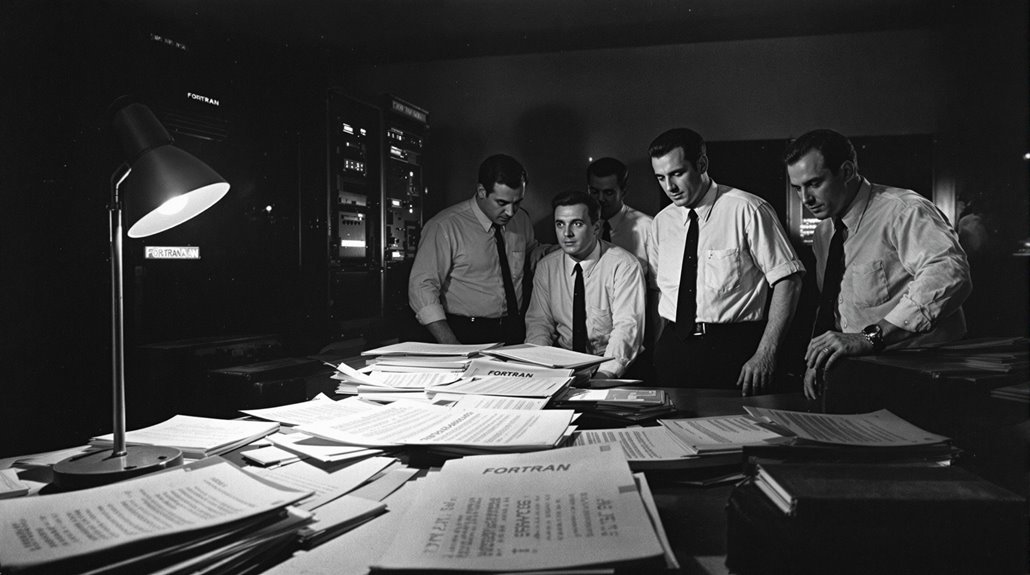
The dawn of high-level programming languages brought both excitement and skepticism, with FORTRAN at the forefront during its creation in the 1950s. As FORTRAN emerged, it promised to transform programming by distancing you from the complexities of machine code. However, many were skeptical about its efficiency compared to low-level languages. Would this high-level language meet the rigorous demands of performance-critical applications?
John Backus and his team faced the formidable challenge of developing an optimizing compiler. Their goal was simple yet complex: translate high-level code into machine code with minimal loss of efficiency. This was essential for FORTRAN's adoption, as many professionals were wary of moving away from the familiar terrain of machine and assembly languages. Skepticism lingered, fueled by concerns about if FORTRAN could truly handle complex numerical tasks with the same precision and speed.
Despite these challenges, FORTRAN had the potential to enhance programmer productivity considerably. By simplifying coding processes, it enabled you to focus more on solving problems than on intricate coding details. Ultimately, FORTRAN's ability to streamline numerical tasks and its successful adoption across industries demonstrated its value, overcoming initial resistance and proving its place in programming history.
Industry Impact
Despite the initial skepticism and challenges faced during its early adoption, FORTRAN's influence on multiple industries became undeniable. As a high-level programming language, it transformed how fields like science and engineering approached complex numerical problems. By 1963, with over 40 FORTRAN compilers available, it had established itself as a standard for scientific computing, enhancing efficiency across different sectors.
FORTRAN's industry impact is profound, particularly in the following areas:
- NASA's Space Missions: It enabled NASA to perform intricate simulations and calculations necessary for space travel, cementing its critical role in the aerospace industry.
- Supercomputing: FORTRAN remains a key language for benchmarking supercomputers, demonstrating its efficiency and enduring relevance in high-performance computing.
- Scientific Research: Its ongoing updates, like FORTRAN 90 and FORTRAN 2008, guarantee it stays relevant in specialized research fields, including weather forecasting, genetics, and fluid dynamics.
Evolution Over Decades

With its roots in the early 1950s, FORTRAN's progression through the decades showcases a remarkable evolution shaped by technological advances and user needs. Initially developed by John Backus and his IBM team beginning in December 1953, FORTRAN emerged as a pioneering high-level programming language. By delivering the primary FORTRAN compiler in April 1957, they enabled programmers to write complex calculations more efficiently than ever.
FORTRAN II, introduced in 1958, marked the language's initial significant step forward by supporting improved compiling processes. As different machines proliferated, FORTRAN IV in 1961 further augmented compatibility, demonstrating the language's adaptability. The American National Standards Institute (ANSI) reinforced FORTRAN's importance by publishing FORTRAN 66 in 1966, the primary formal standard that guaranteed consistency and reliability across systems.
The evolution continued with FORTRAN 77, released in 1978, bringing new features like structured programming constructs. This guaranteed the language remained relevant in the rapidly changing computing landscape. In 1991, FORTRAN 90 introduced substantial enhancements, including array operations and modern programming capabilities, solidifying its role in scientific and engineering applications. Through these decades, FORTRAN has consistently evolved to meet the changing demands of technology and its users.
FORTRAN's Modern Use
In the current fast-paced technological landscape, FORTRAN remains a powerful ally for high-performance computing, particularly in scientific and engineering fields where efficiency and speed are key. You'll find that modern versions of FORTRAN, like Fortran 2008, are equipped with advanced features such as coarrays for parallel processing. These features make FORTRAN relevant for today's computational tasks, allowing it to thrive in industries that demand precision and performance.
Consider the following about FORTRAN's modern use:
- Supercomputers: Many of the world's fastest supercomputers still rely on FORTRAN for running complex applications, particularly those involving intensive numerical computations.
- Industry Applications: Fields like meteorology, aerospace, and computational fluid dynamics continue to depend on FORTRAN's robust capabilities, where it efficiently handles intricate calculations necessary for accurate modeling and simulation.
- Academic Institutions: Despite the evolution of programming languages, academic institutions still teach FORTRAN, underscoring its historical significance and practical applications in scientific research.
Implementing structured data can improve rankings and speed up indexing, providing a competitive edge in search results. With ongoing updates, FORTRAN proves its sustained relevance, maintaining its position as a cornerstone in high-performance computing. Regardless of whether you're tackling intricate scientific problems or spearheading engineering projects, FORTRAN offers the efficiency and capability vital for success.