Creating and Managing Landing Pages With a CMS
Using a CMS to create and manage landing pages streamlines the process, making it accessible to users without technical expertise. User-friendly interfaces and built-in analytics allow you to enhance content, track engagement, and run effective A/B tests to boost conversion rates. This approach ensures consistent branding and messaging, reinforcing your brand identity across all pages. Additionally, the capability to make real-time updates keeps your campaigns relevant. But how do you choose the right CMS and integrate it seamlessly with your landing pages to leverage these benefits? Let's explore this further.
Understanding Landing Pages
In the realm of digital marketing, mastering landing pages is essential for driving conversions and capturing leads. Landing pages are unique web pages designed to achieve a specific objective, such as generating leads or driving conversions, typically after a user clicks on an advertisement or link. Unlike regular website pages, landing pages remove distractions by eliminating navigation options, thereby focusing the visitor's attention solely on the call-to-action (CTA).
To maximize their effectiveness, you should follow best practices. This includes optimizing for speed, ensuring clear and compelling CTAs, and using a thank you page to guide users back to the main website after they have converted. The success of landing pages can significantly influence your digital marketing campaigns, making them one of the most potent methods for lead generation.
Leveraging a content management system (CMS) can simplify the creation and management of landing pages, enabling quick and efficient implementation of changes. Testing various elements, such as headlines and images, on landing pages is crucial for improving conversion rates. By analyzing what performs best, you can refine your strategies and measure the impact of your advertising efforts, ultimately driving higher conversions and better results for your campaigns.
Benefits of Using a CMS
Utilizing a CMS for your landing pages simplifies content updates and ensures consistent brand representation. You don't need technical expertise to make quick changes or maintain a unified design. A CMS helps keep your landing pages aligned with your overall branding and messaging, making the process effortless and efficient.
Streamlined Content Updates
When it comes to managing landing pages, a Content Management System (CMS) greatly simplifies the process, removing the need for extensive coding knowledge. User-friendly WYSIWYG editors enable you to swiftly add, edit, and format content, making updates seamless and efficient. This allows you to manage content across multiple landing pages simultaneously, ideal for running various campaigns.
A CMS also offers built-in version control, allowing you to track changes and revert to previous versions if necessary. This feature is crucial for maintaining content quality and consistency. Moreover, the integration of plugins and extensions, especially on platforms like WordPress, can automate specific updates, thereby freeing you up to focus on more critical tasks.
Many CMS platforms offer a free trial, enabling you to evaluate their capabilities before making a commitment. Below is a quick comparison to illustrate the benefits:
| Feature | Benefit |
|---|---|
| WYSIWYG Editors | Easy to add and format content |
| Manage Multiple Pages | Streamlines updates |
| Version Control | Track and revert changes |
| Plugins and Extensions | Automate updates |
| Free Trial | Assess capabilities before committing |
Enhanced Brand Consistency
Achieving a unified brand experience across all your landing pages is seamless with a Content Management System (CMS). By using CMS platforms like WordPress and Joomla, you ensure that design elements, color schemes, and logos on your landing pages are consistent with those of your main website. This enhances brand recognition and reinforces your brand identity.
A CMS facilitates consistent branding by integrating landing pages with your existing content. This integration ensures that your brand message and user experience remain cohesive. When you update branding elements, a CMS allows you to apply changes across multiple landing pages simultaneously, ensuring your brand identity is instantly reflected everywhere.
Consistent URL structures provided by a CMS further reinforce brand identity and credibility, enhancing customer trust and reducing friction during the user experience. Additionally, CMS platforms come with tools like analytics and A/B testing, enabling you to optimize landing pages while maintaining brand consistency, ultimately leading to improved conversion rates.
Major CMS Platforms
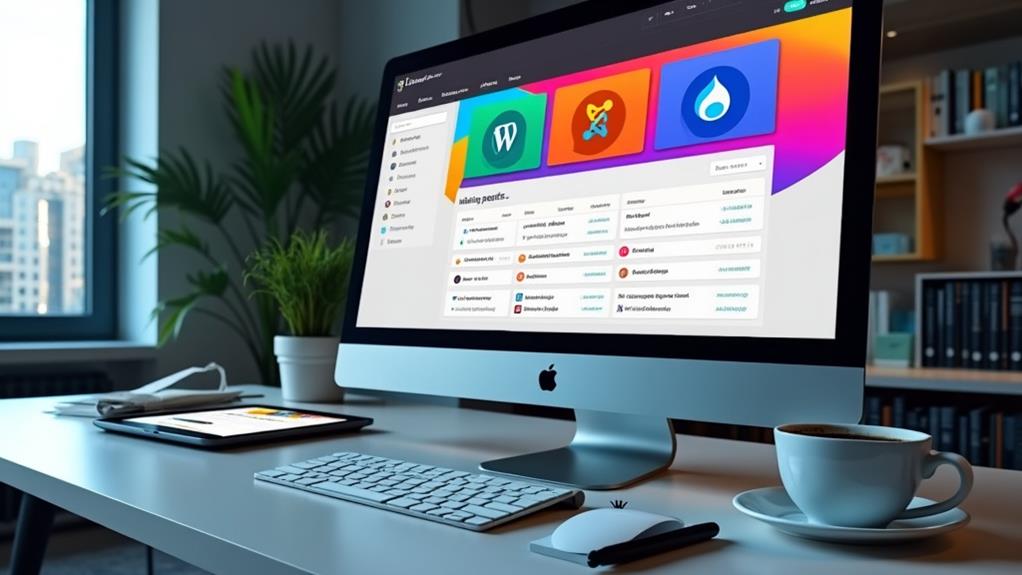
When choosing a Content Management System (CMS) for creating landing pages, three major platforms stand out: WordPress, Drupal, and Joomla. These platforms dominate the market and offer distinct features tailored to various needs.
WordPress is the market leader, commanding approximately 50% of the CMS market share. Its user-friendly interface and extensive library of nearly 50,000 plugins make it ideal for both beginners and advanced users seeking to easily customize their landing pages.
Drupal is the preferred choice for enterprises needing to manage complex data and user interactions. It is well-suited for large organizations and sites with extensive user engagement due to its robust capabilities. For large-scale projects with intricate requirements, Drupal is highly recommended.
Joomla offers a balance between ease of use and advanced features, making it particularly suitable for e-commerce sites and social networking applications. It provides a middle ground between the simplicity of WordPress and the complexity of Drupal, making it a versatile option for diverse needs.
Together, WordPress, Drupal, and Joomla account for over 85% of the CMS market, demonstrating their ability to meet diverse user requirements. Each platform offers unique strengths, allowing you to choose based on ease of use, customization options, and the complexity of your website.
Integrating CMS With Landing Pages
Integrating your CMS with landing pages ensures design and messaging consistency across your website, creating a seamless user experience. Utilizing CMS tools such as analytics plugins allows you to track visitor interactions with your landing pages, offering valuable insights for enhancing engagement. This alignment not only strengthens your brand but also optimizes conversion rates.
Enhancing Brand Consistency
Integrating your landing pages with a Content Management System (CMS) is a highly effective strategy for enhancing brand consistency and maintaining URL uniformity, both of which are crucial for a robust brand identity. Leading CMS platforms like WordPress, Joomla, and Drupal allow you to create landing pages that seamlessly align with your main website's design. This alignment reinforces brand recognition and trust, consistent with Pavlov's principles of frequency and emotional connection, making your brand more memorable.
Using the same CMS for your landing pages ensures that all content conforms to your established brand guidelines. This uniformity prevents customer confusion and enhances the user experience by eliminating distractions, thereby keeping visitors focused on the conversion goals. CMS platforms offer a wide array of plugins and customization options, enabling you to tailor your landing pages to perfectly reflect your comprehensive branding strategy.
Furthermore, maintaining URL consistency across your website and landing pages is essential for effective tracking and analysis. It facilitates the use of tools like Google Analytics to monitor user behavior accurately, ensuring that your marketing efforts are cohesive and measurable. In summary, integrating your landing pages within a CMS is a strategic decision that significantly boosts brand consistency and user engagement.
Tracking User Engagement
Enhancing brand consistency through CMS-integrated landing pages establishes a robust framework for tracking user engagement. Integrating your content management system (CMS) with landing pages unlocks various opportunities for measuring and enhancing user interaction. Here's how you can capitalize on this integration:
- Utilize Analytics Tools: Employ the built-in analytics features or plugins available within your CMS to monitor visitor interactions on your landing pages. This data helps identify which elements drive conversions and which require improvement.
- Track User Behavior: Analyze user engagement metrics such as time spent on the page and click-through rates. These metrics provide insights into user behavior, informing future optimization strategies to meet user expectations effectively.
- Conduct A/B Testing: Use your CMS to facilitate A/B testing on your landing pages. Comparing different versions allows you to determine which variations lead to higher engagement and conversions, enabling data-driven decision-making.
- Optimize Marketing Efforts: Tracking user engagement metrics within your CMS allows you to align marketing strategies with user preferences and behaviors. This ensures your efforts are effective and precisely targeted.
CMS Vs. Landing Page Builders

Choosing between a CMS and a dedicated landing page builder can significantly influence your marketing strategy. A CMS, such as WordPress or Joomla, offers integrated tools for creating landing pages while maintaining brand consistency throughout your entire site. This ensures that your landing pages align seamlessly with the rest of your website, enhancing your brand's cohesive look. Conversely, dedicated landing page builders provide user-friendly interfaces and specialized features for rapid page creation. However, they might not offer the same level of design coherence with your other online platforms.
In terms of customization, CMS platforms excel. They offer advanced customization options through numerous plugins, catering to diverse marketing needs. While this flexibility can sometimes lead to slower performance and the need for manual updates, the level of control you gain is unparalleled. On the other hand, dedicated landing page builders streamline the creation process with sophisticated testing features and analytics tailored specifically for landing pages, though they may limit editing capabilities across multiple pages.
Security is another critical factor. Open-source CMS platforms can be more susceptible to security threats, whereas dedicated landing page builders often include built-in security measures focused on protecting conversion-focused pages.
Ultimately, the choice between a CMS and a dedicated landing page builder depends on your specific needs. If you prioritize brand consistency and advanced customization, a CMS might be the better option. If rapid page creation and specialized testing features are more important to you, a dedicated landing page builder could be more suitable.
Future Trends and Optimization
Future trends in landing page optimization are poised to transform visitor engagement. By emphasizing personalization, you'll tailor content to individual preferences, significantly enhancing user interaction. Leveraging A/B testing will enable you to continuously refine landing page elements based on data-driven insights, ensuring optimal performance.
Key trends to watch include:
- Enhanced Personalization: Utilize visitor data to customize content, making each experience unique and relevant. This approach not only boosts engagement but also increases conversion rates.
- Sophisticated A/B Testing: Employ advanced A/B testing techniques to identify the most effective elements. Continuous iteration based on real-time data will help you fine-tune your landing pages for maximum impact.
- Mobile Optimization: With the rise in mobile traffic, ensure your landing pages are fully optimized for mobile devices. Providing a seamless experience across all devices is crucial for maintaining visitor engagement.
- Interactive Elements: Incorporate features like quizzes and polls to enhance engagement. Interactive elements can significantly increase user interaction and retention, making your pages more effective at capturing leads.
Integrating these trends will place your landing pages at the cutting edge of digital marketing, maximizing both user engagement and conversion rates.