
What Is Beacon Technology in Marketing?
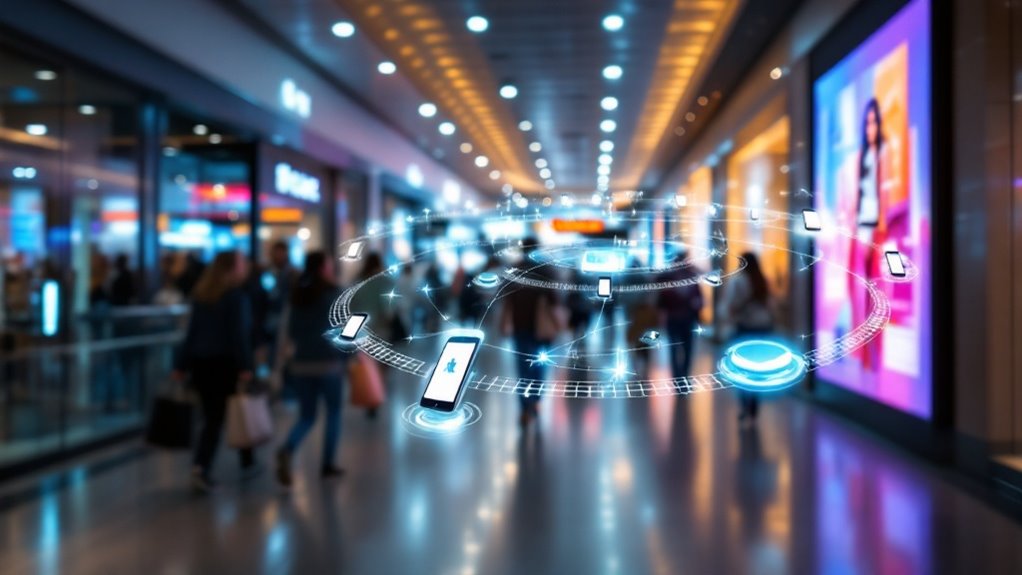
Signal technology in marketing uses small wireless transmitters that send Bluetooth Low Energy signals to nearby smartphones. This allows marketers to deliver personalized notifications and promotions based on your proximity to a store or product, surpassing the accuracy of GPS and WiFi indoors. Apps on your phone need to be compatible to receive these alerts, enhancing shopping experiences with tailored messages. While privacy concerns and initial costs exist, the technology offers deep insights into customer behavior and optimizes retail environments.
Exploring this further will reveal how signals can transform the way you interact with brands and stores.
Understanding Beacon Technology
In the domain of modern marketing, understanding guiding technology is crucial for leveraging its full potential. Beacon technology stands out as a powerful tool to improve customer experience and refine proximity marketing strategies. By using small, wireless transmitters, it broadcasts Bluetooth Low Energy (BLE) signals to nearby devices. This allows you to engage with customers through their smartphones when they're close by, offering personalized notifications and promotions that can greatly increase engagement and sales.
The advantage of beacon technology lies in its precision. It surpasses the accuracy of GPS and WiFi, making it ideal for indoor environments like retail stores. You can analyze customer movement and foot traffic patterns with remarkable detail, which provides invaluable insights for optimizing store layouts and marketing approaches. Imagine knowing exactly where your customers linger and tailoring your strategies accordingly.
As a forward-thinking marketer, you should consider integrating beacons into your campaigns. The market for this technology is projected to exceed $25 billion by 2025, highlighting its growing significance. By doing so, you're not just keeping up with trends; you're actively improving your customer's experience and staying ahead in a competitive market landscape. To fully capitalize on this technology, it's essential to address privacy and opt-in requirements to ensure customer trust and compliance with data protection standards.
How Beacons Function
As you investigate signal technology's role in marketing, understanding how these devices function becomes vital to harnessing their potential. Beacons operate through Bluetooth Low Energy (BLE) signals, transmitting unique identifiers to nearby smartphones. These smartphones need to have compatible apps to receive the signals. Once a smartphone detects a beacon's signal, it can trigger specific actions or notifications based on the user's proximity. This process improves customer experiences by delivering timely and relevant marketing messages.
To make the most out of beacon technology, it's important to have a mobile app with permissions to access location services and Bluetooth. This guarantees seamless communication between the beacon and the user's device. Strategic placement of beacons within a store or location is also fundamental. By optimizing signal coverage and accuracy, you can better determine user locations and tailor marketing efforts accordingly. Compared to GPS and WiFi, beacons offer more precise data on customer movement and engagement. This precision allows for improved customer experiences, as you can provide personalized offers or information right when it's most relevant.
Understanding these functions can greatly enhance your marketing strategies, making interactions more meaningful and effective. Additionally, integrating real-time assistance through chatbots can further enhance customer engagement by providing immediate responses and personalized support.
Evolution and Adoption
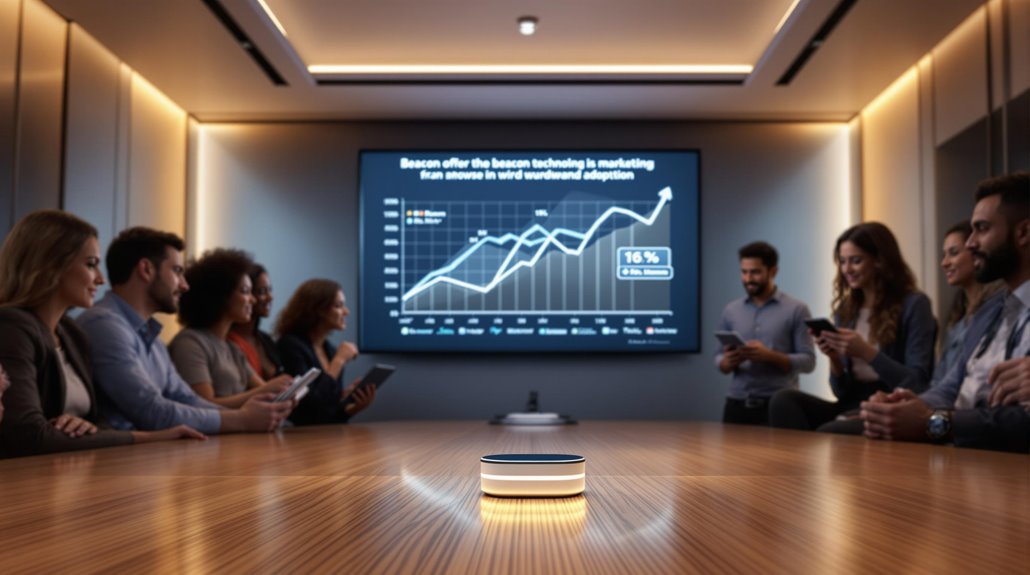
Signal technology has come a long way since its introduction by Apple with the iBeacon standard in 2013. This innovation marked a crucial shift in marketing campaigns, allowing businesses to utilize proximity-based services for improved customer engagement. Apple showcased its potential by installing beacons in 254 US stores by December 2013, a clear proof of early adoption and practical use.
By mid-2014, the beacon technology market saw a surge as over 50 of the Top 100 US retailers began testing this promising tool. They realized beacons could revolutionize location-based marketing, offering personalized experiences to customers right where they shop. As a marketer, you're aware that engaging customers through targeted messages and offers can greatly enhance interaction and brand loyalty.
In 2015, Google upped the ante with Eddystone, a platform-agnostic beacon system that expanded compatibility across multiple devices and platforms. This move not only broadened beacon technology's reach but also highlighted its potential despite initial hurdles like privacy concerns and technical limitations. Today, the beacon market is set to exceed $25 billion by 2025, indicating its growing integration into different business sectors and its crucial role in future marketing strategies.
The success of beacon technology emphasizes the importance of understanding gaming culture and audience preferences to create engaging and personalized marketing content.
Beacon Marketing Explained
Imagine walking into your favorite store and instantly receiving a personalized discount on your phone for that item you've been eyeing. That's the power of beacon marketing at work. By using small Bluetooth devices, businesses can send targeted messages to nearby smartphones. This isn't just any message—it's personalized, based on your physical proximity to specific locations or products within a store.
Beacon marketing greatly improves customer engagement by delivering real-time notifications, like exclusive discounts or promotions, just as you near a store or a particular item. Major brands such as McDonald's and Tesco are already leveraging this technology to elevate sales and enrich their customers' experiences. When you approach their locations, you're alerted to deals, making shopping both convenient and rewarding.
But how does it work? It relies on Bluetooth technology to communicate with your phone. However, it requires users to opt in through mobile apps, so brands must build trust and guarantee smooth user experiences to encourage participation. Beyond immediate sales, beacon marketing belongs to the broader category of proximity marketing, offering valuable insights into customer behavior and foot traffic patterns through data analytics after campaigns.
Benefits of Using Beacons

You've seen how signal marketing works its magic by sending personalized messages to your smartphone, and now let's investigate the tangible advantages this technology brings to businesses. Beacon technology improves personalized marketing by delivering targeted promotions to customers based on their exact location. This precision leads to higher engagement rates and ultimately elevates sales opportunities. By using beacons, you can transform the shopping experience, making it more engaging and relevant for each customer.
One of the significant benefits is the collection of granular customer data. Businesses can analyze foot traffic and shopper behavior, gaining valuable insights to optimize marketing strategies and improve store layouts. This data-driven approach guarantees you're making informed decisions that enhance customer satisfaction.
Beacons also facilitate seamless experiences, like in-store navigation and real-time notifications, which contribute to higher customer satisfaction and retention. By integrating beacons into loyalty programs, you can increase app engagement, encourage repeat visits, and build stronger brand loyalty.
Additionally, retailers using beacon technology report better attribution of in-store visits to online advertising efforts. This improves the effectiveness of your marketing campaigns, assuring that your investments yield the desired results. Moreover, integrating beacon technology with a CMS in digital marketing can further enhance content personalization and customer engagement by utilizing AI-driven insights.
Challenges and Limitations
Navigating through the challenges of signal technology reveals several limitations that companies must consider. One significant obstacle is privacy concerns. Beacon technology relies on user consent for tracking, meaning if users disable Bluetooth or decline app permissions, the technology's effectiveness is compromised. This can deter customers, impacting general adoption rates and making it more difficult to justify the investment.
Signal strength also poses issues. Variations can cause inaccuracies in location detection, leading to missed or delayed notifications. This diminishes their relevance and can frustrate users, potentially reducing engagement. Ensuring consistent signal strength is essential for maintaining accurate, timely interactions with customers.
Scalability challenges further complicate the deployment of beacon technology. Implementing beacons across multiple locations demands a substantial investment in infrastructure and ongoing maintenance. This can be challenging for businesses, especially smaller ones, looking to utilize this technology across their entire footprint.
Moreover, for beacon marketing to be effective, it requires a tech-savvy customer base with high smartphone penetration. This isn't always the case in all demographics or regions, limiting the reach and potential success of beacon campaigns. Companies must weigh these factors when considering a beacon strategy.
Real-World Applications
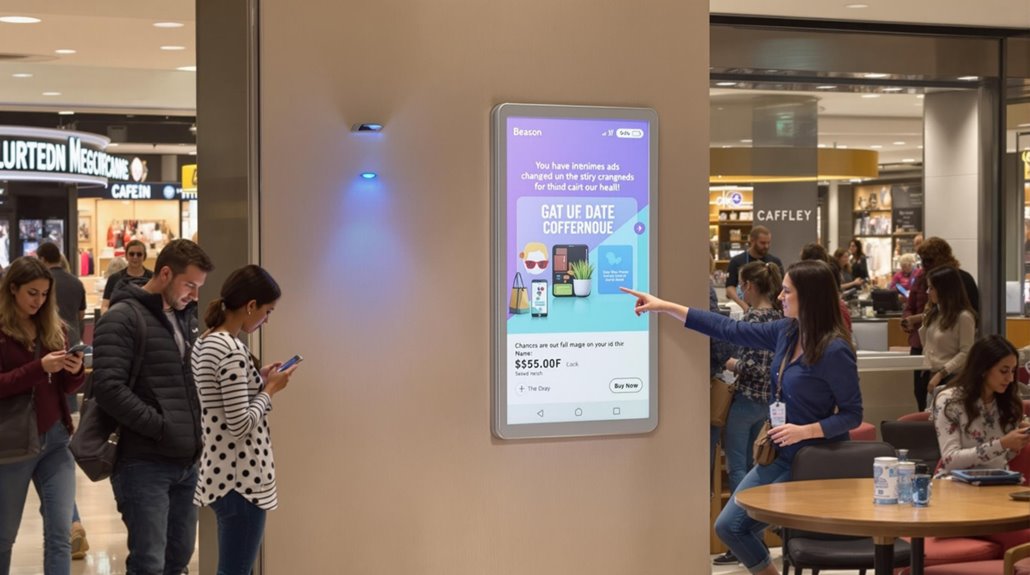
In the current fast-paced retail landscape, guiding light technology is making a significant impact by enhancing customer experiences and streamlining operations. Signal technology is at the forefront of this transformation, facilitating personalized notifications and elevating customer engagement in diverse real-world applications. For instance, Macy's has transformed in-store shopping by installing over 4,000 signals, which send personalized deal alerts directly to shoppers' smartphones, making their experience more interactive and engaging.
Amazon Go takes signal technology a step further by creating a cashier-less shopping environment. Here, signals enable seamless transactions, eliminating checkout lines and enhancing convenience. At Target, GPS-connected carts use signal signals to guide you to items and offer tailored recommendations based on your past purchases, making shopping more efficient and personalized.
CVS Health uses signals to deliver real-time service notifications, resulting in a 72% improvement in customer experiences. Meanwhile, Neiman Marcus has adopted iBeacon technology to provide event notifications and assist you with in-store directions, offering a personalized and seamless shopping experience. These examples showcase how signal technology is reshaping the retail landscape, fostering deeper customer engagement, and offering tailored experiences like never before. By integrating gaming mechanics into marketing strategies, companies can achieve up to 3x higher retention rates, further enhancing customer loyalty and engagement.
Future Prospects and Innovations
As signal technology continues its rapid evolution, it's opening up a world of possibilities for future innovations and applications. With the guiding technology market expected to exceed $25 billion by 2025, there's no shortage of growth and investment opportunities in proximity marketing. You're about to witness some exciting advancements that could redefine the customer experience and beyond.
Here's what you can expect:
- AI Guiding Devices: Introduced by Estimote in 2019, these devices are already improving functionality with features like motion detection and gesture recognition. Imagine a store that can tailor promotions based on your movements or gestures—it's not far off.
- Integration with Emerging Technologies: The fusion of guiding devices with augmented reality and machine learning is set to create more engaging experiences. Picture walking into a store and receiving a personalized AR tour on your smartphone, customized just for you.
- Expansion into New Sectors: Guiding devices are not just limited to retail. They're poised to revolutionize logistics and transportation with improved tracking and efficiency.
As these innovations unfold, the focus on consumer data security will be paramount. Improved protection measures will help build trust, encouraging wider adoption of this transformative technology.