
Is HTML Is a Programming Language?

HTML isn't a programming language; it's a markup language that structures web content. Unlike programming languages, HTML doesn't perform calculations or logical operations. Instead, it uses tags to format and present text, images, and multimedia, establishing the foundation for web pages. While often bundled with CSS and JavaScript, HTML's role is to dictate content appearance, not process it. Some folks mistakenly call it a programming language because of its critical role in web development.
Understanding the clear distinction between markup and programming languages can deepen your grasp of web technologies and their functions.
Understanding HTML's Purpose
When you engage yourself in the world of web development, HTML quickly comes into play as the backbone of web content. HTML, or HyperText Markup Language, is the fundamental tool used to structure and present content on the web, including text, images, and multimedia elements. It's imperative to understand that while HTML is significant in web development, it doesn't function as a traditional programming language.
Unlike programming languages, HTML can't manipulate data, perform calculations, or execute logical operations. Instead, it defines the layout and organization of your web page using tags. These tags are the building blocks that allow you to create elements like headings, paragraphs, links, and lists. This semantic organization is what makes HTML indispensable for anyone commencing in web development. While it's the initial step on your path, HTML alone can't create a fully interactive web page. For that, you'll need to combine it with CSS for styling and JavaScript to add interactivity. By mastering HTML, you establish a solid foundation, preparing you to tackle more complex programming languages and tasks in the web development process.
Understanding HTML's purpose sets the stage for your continued learning. Responsive design ensures that the web pages you create remain functional and visually appealing across all devices, which is crucial for optimizing search engine visibility.
Markup vs. Programming Languages
The distinction between markup languages and programming languages is vital in understanding their respective roles in technology. Markup languages, like HTML, define how content should appear on a web page. They focus on structure and presentation, not on executing commands or performing logical operations. In contrast, programming languages are designed to perform complex computations and logic, making them more dynamic and functional.
Here's how they differ:
- Purpose: Markup languages describe data and structure content, while programming languages solve problems and manipulate data.
- Functionality: HTML can't perform logical operations like conditional statements or loops, whereas programming languages like Python or Java can.
- Nature: Markup languages are declarative, focusing on the "what" of content display. Programming languages are procedural, focusing on the "how" of executing tasks.
- Capabilities: HTML is a foundational tool for web page structure. Programming languages are robust, capable of developing full applications.
Understanding these differences is fundamental. While HTML is an invaluable markup language for web design, it lacks the capabilities of a computer language required to perform logical tasks, which is where programming languages excel. Implementing structured data using schema and rich snippets can significantly enhance search engine visibility and improve website performance.
Common HTML Misconceptions
Although HTML is fundamental to web development, it's often misunderstood as a programming language. This misconception primarily arises because HTML is used alongside true programming languages like JavaScript and CSS. However, HTML is actually a markup language, specifically designed to structure and present content on the web. Unlike programming languages, HTML lacks vital features like variables, loops, and conditional statements.
You might come across some educational resources or forums that mistakenly refer to HTML as a programming language. This misinterpretation can lead to confusion about its capabilities. HTML's role is to dictate how content should be displayed, not to perform logical operations or execute commands. This is a key distinction that sets markup languages apart from programming languages in web development.
Community debates often stem from a broader definition of programming that includes any language influencing computer behavior. However, technically speaking, HTML doesn't fulfill the criteria of a programming language. It simply marks up the text to tell web browsers how to display the content. By understanding these misconceptions, you'll better appreciate HTML's true purpose and the significance of distinguishing it from languages that actually control program logic and flow. Notably, WordPress SEO by Yoast is a comprehensive package that supports social media integration and is used by major sites, showcasing the importance of distinguishing tools that enhance web content from those that build its structure.
HTML in Web Development
As a cornerstone of web development, HTML forms the foundation for building and structuring web content. It's the initial step in creating an HTML page where all your text, images, and multimedia come to life. HTML uses a series of elements and tags that lay out the blueprint for your webpage, making it easier for browsers to interpret and present to users. While HTML itself isn't programming in the traditional sense, it's vital for integrating CSS for styling and JavaScript for interactivity, crafting a dynamic web experience. WordPress is recognized for its stability and resource availability, which makes it a popular choice for building websites using HTML. Here's how HTML fits into web development:
- Structure: HTML organizes your content with layered elements like headings, paragraphs, and lists, ensuring a well-structured HTML page.
- Styling: When paired with CSS, HTML defines the look and feel, transforming plain text into visually appealing designs.
- Interactivity: HTML sets the stage for JavaScript, enabling interactive and dynamic elements that engage users.
- Accessibility and SEO: Semantic HTML elements improve accessibility and SEO, providing context to search engines and assistive tech.
Understanding HTML is fundamental in the web arena, acting as the backbone of every web project you undertake.
Community Perspectives on HTML
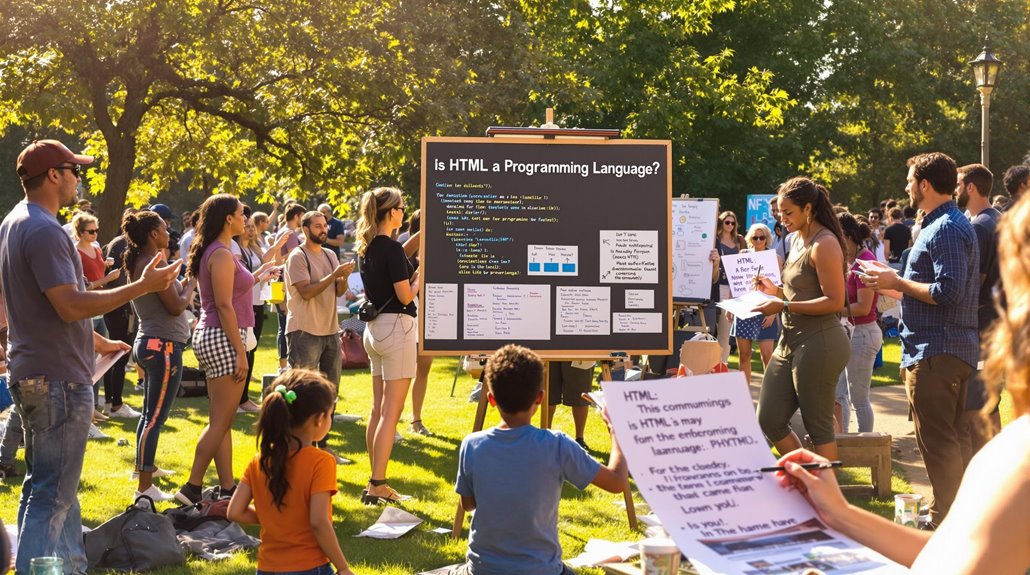
In the coding community, debates about if HTML qualifies as a programming language are common. Some argue in favor of its classification as a programming language due to its essential role in web development. However, many developers emphasize that HTML is fundamentally a markup language. They point out that it lacks the capability to execute logic or perform calculations independently, which are typical characteristics of programming languages.
These discussions often explore HTML's practical applications, especially when it's combined with CSS and JavaScript to create dynamic web content. Such combinations can lead to diverse interpretations of what truly constitutes a programming language. The ambiguity in defining programming languages adds fuel to these debates. Some advocate for broader definitions that encompass markup languages like HTML, arguing that its utility in the web development process warrants its inclusion.
User experiences and opinions shared on platforms like Stack Overflow highlight the complexity of HTML's role. You'll find that while some in the community see HTML as a stepping stone to more advanced programming, others see it as an integral part of a broader programming ecosystem. This diversity of perspectives keeps the conversation alive and evolving.